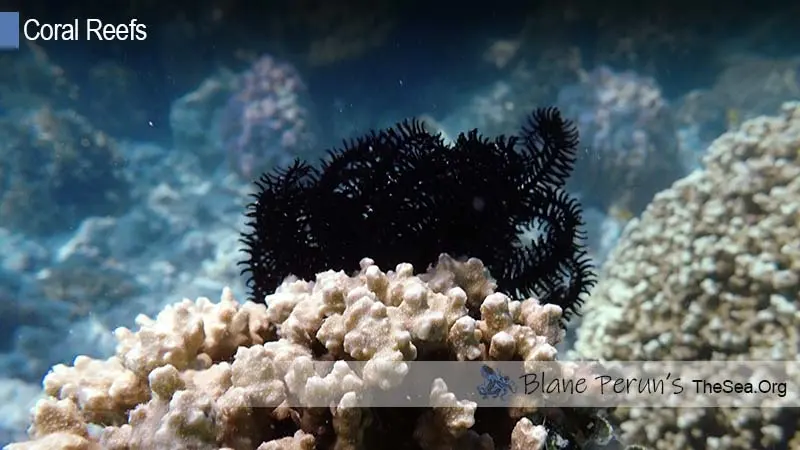
A coral reef is a complex underwater ecosystem built from the calcium carbonate skeletons of coral polyps — tiny, soft-bodied animals related to jellyfish and sea anemones. Over thousands of years, as generations of coral polyps grow, reproduce, and die, their skeletons accumulate into the massive limestone structures we recognize as reefs. Despite covering less than 1% of the ocean floor, coral reefs support an estimated 25% of all marine species on Earth.
What Is a Coral Reef, Exactly?
The definition often surprises people: coral reefs are not plants, rocks, or inanimate structures. They are living ecosystems built by animals. Each coral colony is made up of hundreds to thousands of individual polyps — animals roughly the size of a pencil eraser — that extract calcium and carbonate ions from seawater to build a hard external skeleton called a corallite.
Inside most reef-building coral polyps live microscopic algae called zooxanthellae. This relationship is one of the most important symbioses in the ocean: the algae photosynthesize and provide the coral with up to 90% of its energy needs, while the coral provides the algae with shelter and nutrients. The vivid colors of healthy coral reefs come almost entirely from these algae.
Types of Coral Reefs
Charles Darwin first classified coral reefs into three main types during his voyage on the HMS Beagle, and his framework is still used today:
- Fringing reefs: The most common type. These grow directly from the shoreline, with little or no lagoon between the reef and the coast. Examples include reefs along the Red Sea coast and much of the Caribbean.
- Barrier reefs: Separated from the mainland by a deep lagoon. The Great Barrier Reef off Queensland, Australia is the world’s largest — stretching over 2,300 km and visible from space.
- Atolls: Ring-shaped reefs that encircle a central lagoon, typically forming over volcanic islands that have subsided below sea level. The Maldives and Marshall Islands are classic examples.
A fourth category — patch reefs — refers to isolated, smaller reef structures that grow within lagoons and on continental shelves, disconnected from larger reef systems.
Where Are Coral Reefs Found?
Coral reefs are concentrated in a band roughly between 30°N and 30°S latitude, where ocean temperatures stay between 23°C and 29°C year-round. They require clear, shallow water — most reef-building corals grow in depths less than 50 meters where sunlight can penetrate for zooxanthellae photosynthesis.
The Coral Triangle — spanning Indonesia, Malaysia, the Philippines, Papua New Guinea, Timor-Leste, and the Solomon Islands — is the global center of marine biodiversity, home to over 600 coral species and 2,000 reef fish species. The Caribbean, Red Sea, Great Barrier Reef, and reefs of the Indian Ocean are other major systems.
Why Are Coral Reefs Important?
The ecological and economic value of coral reefs is extraordinary relative to their size:
- Biodiversity: Reefs support 25% of all ocean species on less than 1% of the seafloor — rivaling tropical rainforests in species density per area.
- Fisheries: An estimated 500 million people depend on coral reef fisheries for food and income, particularly in developing nations across the Pacific and Indian Oceans.
- Coastal protection: Reefs absorb up to 97% of wave energy before it reaches shore, protecting coastlines from erosion, storm surge, and flooding.
- Medicine: Coral reef organisms have yielded compounds used in treatments for cancer, HIV, cardiovascular disease, and pain management. Many more await discovery.
- Economic value: Global coral reef tourism generates an estimated $36 billion annually. Total economic value including fisheries, coastal protection, and tourism is estimated at over $375 billion per year.
Coral Reef Structure: How a Reef Is Built
Reef formation is extraordinarily slow — most reefs grow between 1 and 3 centimeters per year vertically, though some massive coral structures grow as little as 0.3 cm per year. The Great Barrier Reef began forming approximately 20,000 years ago, though the current structure is far younger.
A typical reef has distinct zones:
- Fore reef / reef slope: The seaward face of the reef, exposed to open ocean currents and the highest wave energy. Often the most biologically diverse zone.
- Reef crest: The shallowest point, often exposed at low tide. Corals here are extremely stress-tolerant.
- Back reef / lagoon: The sheltered zone between the reef crest and shore. Generally calmer and shallower, with sandy substrate and seagrass beds.
Threats to Coral Reefs
Coral reefs are among the most threatened ecosystems on Earth. The primary threats include:
- Climate change and coral bleaching: When water temperatures rise even 1–2°C above normal for extended periods, corals expel their zooxanthellae — losing their color and their primary food source. This is coral bleaching. Bleached corals can recover if temperatures drop, but sustained bleaching leads to death. Mass bleaching events have increased dramatically since the 1980s.
- Ocean acidification: As the ocean absorbs atmospheric CO₂, it becomes more acidic. This reduces the availability of calcium carbonate ions corals need to build their skeletons, weakening reef structures over time.
- Overfishing: Removing herbivorous fish allows algae to overgrow and smother corals. Removing apex predators destabilizes entire reef food webs.
- Coastal development and runoff: Sediment and nutrient pollution from agriculture and development cloud water (blocking sunlight) and fuel algae blooms.
- Destructive fishing: Blast fishing and cyanide fishing directly destroy reef structure and kill non-target species indiscriminately.
Coral Reef Definition — Key Facts
- Built by: Coral polyps (animals, not plants)
- Material: Calcium carbonate (limestone) skeletons
- Growth rate: 1–3 cm per year (vertical)
- Ocean coverage: Less than 1% of the seafloor
- Species supported: ~25% of all marine species
- Primary threat: Climate change and ocean warming
- Largest reef system: Great Barrier Reef, Australia (2,300+ km)
Frequently Asked Questions
Are corals plants or animals?
Corals are animals — specifically, they are invertebrates in the phylum Cnidaria, related to jellyfish and sea anemones. Each individual coral polyp is an animal that builds a calcium carbonate skeleton around itself.
How long does it take a coral reef to form?
Coral reefs develop over thousands to millions of years. Individual corals grow just 1–3 cm per year. The Great Barrier Reef’s current structure is estimated to be around 6,000–8,000 years old, though reef building in the region began much earlier.
Can coral reefs survive climate change?
Some coral species are more heat-tolerant than others, and researchers are working on assisted evolution projects to develop more resilient strains. However, without significant reductions in carbon emissions, most projections suggest that 70–90% of existing reefs will be severely degraded by 2050.
What is the difference between hard coral and soft coral?
Hard corals (scleractinians) build rigid calcium carbonate skeletons and are the primary reef builders. Soft corals lack hard skeletons and instead have flexible internal structures called sclerites. Soft corals contribute to reef ecosystems but do not build the limestone framework.
What percentage of the ocean floor do coral reefs cover?
Coral reefs cover less than 1% of the ocean floor — approximately 284,000 square kilometers globally. Despite this tiny footprint, they support an estimated 25% of all marine species.